
How Do I Start the VA Loan Process? A Step-by-Step Guide for Veterans (2026)
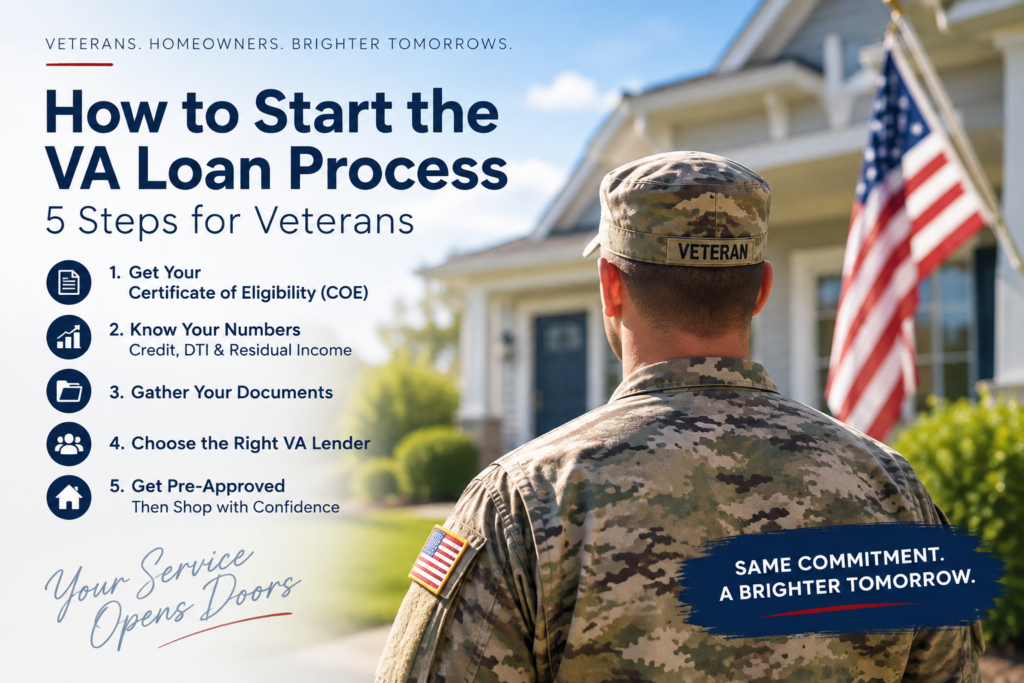
To start the VA loan process, request your Certificate of Eligibility (COE), check your credit, income, and residual income, gather your documents, and apply for pre-approval with a VA lender that does not add its own restrictions on top of VA guidelines. Most veterans can finish these steps before they ever look at a home, and doing them in the right order keeps surprises out of underwriting.
This guide walks through each step, what to bring, and the questions to ask a lender. It is written for veterans, active-duty service members, and eligible surviving spouses who are ready to buy a home.
|
THE 5 STEPS AT A GLANCE |
|
1. Get your Certificate of Eligibility (COE) 2. Know your numbers: credit, debt-to-income (DTI), and residual income 3. Gather your documents 4. Choose the right VA lender (compare more than the rate) 5. Get pre-approved, then shop with confidence |
Step 1: Get Your Certificate of Eligibility (COE)
The COE is your proof to lenders that you meet the VA’s minimum service requirements. Service requirements vary by era and by whether you served on active duty, in the National Guard, or in the Reserves, and eligible surviving spouses of service members may qualify as well.
You can request your COE three ways: online through VA.gov, through your lender, or by mail. Many veterans simply ask their lender to pull it electronically. Have your DD-214 (discharge papers) handy if you are a veteran, or a statement of service if you are still on active duty.
|
GOOD TO KNOW: A COE IS NOT A LOAN APPROVAL |
|
The COE only shows that you have met the minimum service requirements. It does not guarantee you will be approved for a loan. Your credit, income, and the property still have to be underwritten. |
|
THE LOANGOAL ADVANTAGE: ENTITLEMENT AND LOAN LIMITS |
|
Since 2020, Veterans with full entitlement have no VA loan limit. If you have used your VA benefit before and have not restored it, your available entitlement may be reduced. Check where you stand with our free 2026 VA Partial Entitlement Calculator, or ask us to review your COE. |
Step 2: Know Your Numbers (Credit, DTI, and Residual Income)
Before you apply, get a clear picture of three things the VA and your underwriter will look at.
Credit score
The VA has no minimum credit score. When a lender says you need a 620, that is the lender’s own policy, called a lender overlay. It is stricter than what the VA actually requires. Access Capital Group, Inc. — LoanGoal has been a No Overlay Lender since 2001, and we can approve VA loans with scores down to 500 through manual underwriting.
Debt-to-income ratio (DTI)
DTI is your total monthly debts (including the proposed mortgage payment) divided by your gross monthly income. The VA’s published guideline is 41%, but it is a guideline, not a hard cap. Loans above 41% can be approved when there are compensating factors, especially strong residual income.
Residual income
Residual income is what is left each month after your mortgage payment, debts, taxes, and estimated maintenance and utilities. It is one of the VA’s most important approval measures, and it varies by family size, loan amount, and region. Try our free VA Residual Income Calculator to see your numbers the way an underwriter will.
|
GOOD TO KNOW: NON-TAXABLE INCOME CAN HELP |
|
Income such as BAH, BAS, and VA disability compensation is non-taxable. Under VA guidelines, lenders can gross up non-taxable income by up to 25% when qualifying you, so $2,000 a month in BAH can count as $2,500. That can meaningfully increase your buying power. |
Step 3: Gather Your Documents
Having your paperwork ready is the fastest way to keep your file moving. Here is what most VA lenders will ask for:
|
Document |
Why the lender needs it |
|
COE and DD-214 (or statement of service) |
Proves your VA eligibility and service history. |
|
Recent pay stubs (and LES if active duty) |
Verifies current income, including BAH and BAS. |
|
W-2s from recent years |
Documents your income history. Self-employed borrowers should expect to provide tax returns and a profit-and-loss statement. |
|
Recent bank statements |
Shows funds for any deposits and closing costs, and your cash reserves. |
|
VA award letter (if you receive disability compensation) |
Counts as income and can waive the VA funding fee. |
|
Written explanations for credit events or employment gaps |
Manual underwriting relies on the story behind the numbers, such as deployment, medical leave, or school. |
Step 4: Choose the Right VA Lender (Compare More Than the Rate)
It pays to talk to more than one lender, and to compare interest rates, origination charges, and lender fees. But rate is only part of the picture. Ask every lender these questions:
- Do you have overlays? What is your minimum credit score and your maximum DTI on a VA loan?
- Do you offer manual underwriting when the automated system returns a “Refer” result?
- What are your origination charges and lender fees? Get the numbers in writing.
- What will my funding fee be, and am I exempt because of a service-connected disability?
- Can the seller pay my closing costs on this purchase?
Here is how a typical lender with overlays compares to a no-overlay VA lender:
|
|
Typical lender with overlays |
LoanGoal (no overlays) |
|
Minimum credit score |
Often 620 or higher, set by the lender |
No VA minimum; manual underwriting down to 500 |
|
DTI limit |
Some apply a hard 41% cap |
41% is a guideline; higher DTI can be approved with compensating factors such as strong residual income |
|
Automated "Refer" result |
Often a decline |
The start of a manual underwriting review |
|
After bankruptcy or foreclosure |
Some require 3 to 4 years |
VA minimums: Chapter 7, 2 years from discharge; foreclosure, 2 years; Chapter 13, 12 months of on-time plan payments with trustee approval |
|
THE LOANGOAL ADVANTAGE: NO OVERLAYS SINCE 2001 |
|
The most common reason a Veteran is declined is a lender's own credit-score rule, not the VA's. Because we follow VA underwriting guidelines directly, we can often review a Veteran for a manual underwrite even if they have been told no. Every loan is individually underwritten and approval is not guaranteed. |
|
GOOD TO KNOW: THE VA FUNDING FEE |
|
Most VA purchase loans include a one-time funding fee, generally between 2.15% and 3.3% depending on your situation. It is waived for veterans who receive VA disability compensation, and it can usually be financed into the loan. VA loans do not require monthly mortgage insurance. |
Step 5: Get Pre-Approved, Then Shop With Confidence
Pre-approval is when your lender reviews your credit, income, and assets and issues a letter showing the maximum loan amount you may qualify for. You then use that letter to shop for homes and make serious offers. It also tells you early if anything needs attention.
At LoanGoal, you can get started three ways: call 602-648-5860, apply online, or complete our VA Manual Underwrite Questionnaire if your credit or DTI has made things harder in the past.
|
VETERAN PROFILE: A SECOND LOOK AFTER A "NO" |
|
Illustrative scenario for educational purposes. It is not a specific client, and results vary. The situation: Daniel is an Air Force veteran with a 596 credit score, a 44% DTI, and 14 months of on-time payments since a rough patch after his separation. A bank tells him he needs a 620 and a DTI under 41%. What we look at: Neither number is a VA rule. They are that bank's overlays. We start with his COE, then review his recent payment history, employment, and residual income, which is well above the regional minimum. The takeaway: With strong residual income and a clean recent payment history, Daniel has a workable path to a manual underwrite review. That is the kind of file a no-overlay lender is built to evaluate. Any approval depends on full underwriting. |
What happens after pre-approval
- Find a VA-savvy real estate agent who understands VA appraisals and property requirements.
- Make your offer with your pre-approval letter. On VA purchases, sellers can pay the Veteran’s closing costs, plus up to 4% in additional concessions.
- Expect a VA appraisal and a review of the VA’s Minimum Property Requirements. See our VA Loan Property Rules FAQ.
- Close on your home, typically with no down payment for eligible veterans with full entitlement.
Want the full picture on qualifying? Read our VA Loan Approval Guidelines, or see what to think about before you buy once you are VA-qualified. For the VA’s own overview, visit the VA.gov home-buying process page.
|
READY TO START? TALK TO A VA LOAN SPECIALIST |
|
Access Capital Group, Inc. — LoanGoal has specialized in VA loans since 2001. Call 602-648-5860 (toll-free 866-204-4288), visit loangoal.com, or apply online. Thank you for your service. Let us handle the loan. |
Frequently Asked Questions: Starting the VA Loan Process
What is the first step to getting a VA loan?
The first step is confirming your eligibility and getting your Certificate of Eligibility (COE). Most veterans then talk to a VA lender about their credit, income, and residual income before applying for pre-approval, so there are no surprises later in underwriting.
How do I get my VA Certificate of Eligibility (COE)?
You can request your COE online at VA.gov, through your lender, or by mail. Many veterans simply ask their lender to pull it electronically. You will generally need your DD-214 (or a statement of service if you are still on active duty).
What documents do I need to apply for a VA loan?
Plan on your COE and DD-214, recent pay stubs, W-2s, and recent bank statements. If you receive VA disability compensation, bring your VA award letter. Self-employed borrowers should expect to provide tax returns, and any credit or employment gaps should be explained in writing.
Is there a minimum credit score for a VA loan?
No. The VA does not set a minimum credit score. Many lenders add their own minimum, often 620, which is called a lender overlay. Access Capital Group, Inc. — LoanGoal has been a no-overlay lender since 2001 and can manually underwrite VA loans with credit scores down to 500.
Do I need a down payment for a VA loan?
Most eligible veterans with full entitlement can buy with no down payment and no monthly mortgage insurance. If you have used your VA benefit before and have not restored it, you may need a down payment on larger loan amounts. Our VA Partial Entitlement Calculator can help you estimate.
Can I still get a VA loan if another lender turned me down?
Possibly. Many VA denials come from lender overlays such as a 620 minimum score or a hard 41% DTI cap, not from VA guidelines. A second review with a no-overlay lender that offers manual underwriting may open a path. Every file is underwritten individually, and approval is not guaranteed.
What is residual income on a VA loan?
Residual income is the money left each month after your proposed mortgage payment, debts, taxes, and estimated maintenance and utilities. It is one of the VA’s most important approval measures, and strong residual income can offset a higher debt-to-income ratio or lower credit score.
How much is the VA funding fee?
The VA funding fee is a one-time charge, generally between 2.15% and 3.3% on most purchase loans depending on your situation. It is waived for veterans who receive VA disability compensation, and it can usually be financed into the loan.