
Renting vs. Buying: Why Your Credit Score Might Make Homeownership Easier Than Renting
LoanGoal Blog · Access Capital Group, Inc. — LoanGoal · NMLS #33043
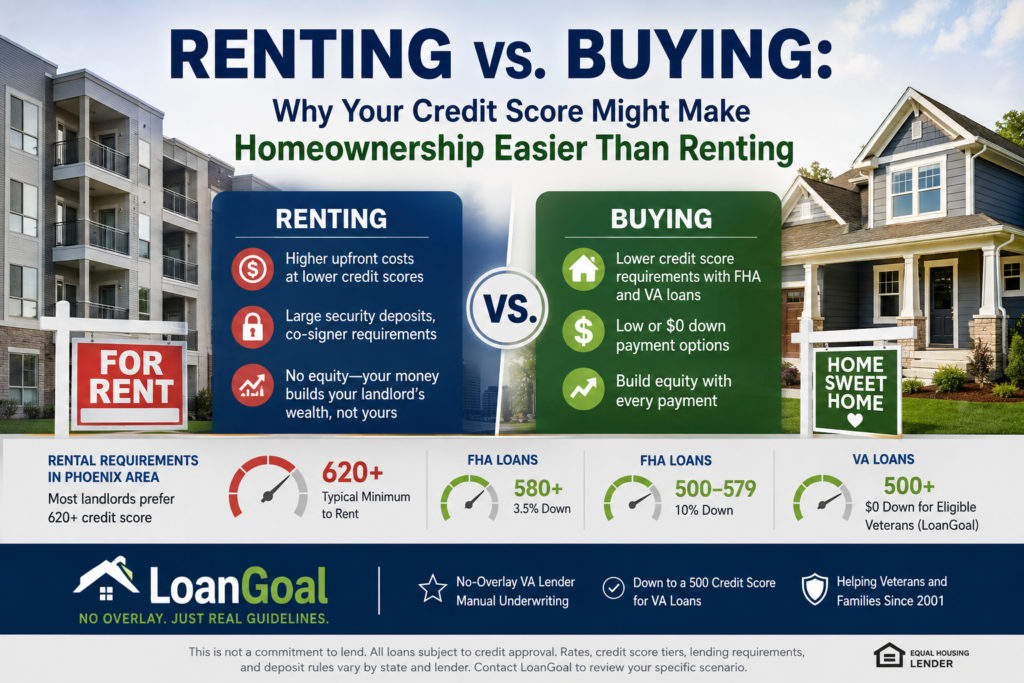
A prospective home buyer told us something we hear more often every year: renting an apartment has gotten harder to qualify for than buying a house.
It sounds backwards, but once you line up the numbers side by side, it holds up, especially for buyers using FHA or VA financing.
Most landlords in the Phoenix area screen for a credit score of 620 or higher, and applicants below that range are usually asked for a bigger deposit, a co-signer, or both.
Compare that to FHA, which allows a 580 score with 3.5% down, or VA financing, where LoanGoal underwrites manually down to a 500 score with zero down for eligible Veterans.
In a lot of cases, the credit bar to buy is lower than the bar to rent.
The LoanGoal Advantage
We’re a no-overlay VA lender.
Where most banks quietly raise FHA and VA credit requirements 40–60 points above the government floor, LoanGoal underwrites manually down to a 500 score, the same floor HUD and the VA actually allow.
That means a borrower who gets turned away by a big-box lender’s overlay, or by a landlord’s screening service, may still qualify for a mortgage with us.
Rent vs. FHA vs. VA: Credit Score and Cash Needed
Here’s how the three paths compare at every credit tier, using a $250,000 purchase price and roughly $2,000 monthly rent as the reference points.
| Housing Path | Credit Score | Cash Needed Upfront | What You Walk Away With |
|---|---|---|---|
| Rent — Excellent Credit | 740+ | 1 month’s rent, or a flat fee as low as $200–$500 | Nothing — no equity, no ownership |
| Rent — Good/Fair Credit | 620–739 | 1 month’s rent (standard deposit) | Nothing — landlord keeps the deposit as security |
| Rent — Low Credit | 580–619 | 1.5–2 months’ rent, often plus a co-signer | Nothing — higher cash outlay, still no equity |
| Rent — Poor Credit | 500–579 | 2–3 months’ rent where state law allows (first, last, deposit) | Nothing — the largest upfront cost of any option here |
| FHA Purchase | 580+ | 3.5% down (≈ $8,750 on a $250K home) | A home you own and equity that builds every month |
| FHA Purchase | 500–579 | 10% down (≈ $25,000 on a $250K home) | A home you own and equity that builds every month |
| VA Purchase (LoanGoal) | 500+ (no overlay, manual underwrite) | $0 down for eligible Veterans and service members | A home you own, equity, and no monthly mortgage insurance |
Why This Matters
A renter with a 550 credit score putting down two to three months’ rent on a $2,000/month apartment is handing over $4,000–$6,000 upfront, money the landlord keeps as security and that builds the renter zero equity.
A Veteran with that same 550 score, working with a lender who actually underwrites to VA’s real guidelines, can close on a home with $0 down and start building equity with the very first payment.
The “overlay” is the gap between what FHA or VA actually allow and what a given lender chooses to require.
It’s one of the biggest reasons qualified buyers get told no.
Sellers Can Cover the Buyer’s Closing Costs Too
The comparison above only counts the down payment.
On many FHA and VA purchases, the seller can also agree to pay some or all of the buyer’s closing costs, pushing the buyer’s total cash-to-close even lower relative to a rental deposit.
- FHA: The seller, or another interested party, can contribute up to 6% of the sales price toward the buyer’s closing costs, prepaid items, and discount points.
- VA: The seller can pay the buyer’s normal closing costs, plus up to an additional 4% of the home’s value in certain concessions.
None of this is automatic. It has to be negotiated into the purchase contract.
But in a market where sellers are motivated, these concessions can make a significant difference.
A buyer who negotiates seller-paid closing costs alongside FHA’s 3.5% down or VA’s $0 down may be able to substantially reduce the amount needed out of pocket, while a low-credit renter may still be writing a check for two or three months’ rent just to get the keys.
The LoanGoal Advantage
Because we underwrite manually and know FHA and VA guidelines inside and out, we help buyers structure offers that ask for seller-paid closing costs from the start, not as an afterthought once the contract is already signed.
What Drives the Rental Deposit Up
Security deposit requirements vary by state. California and New York, for example, cap deposits at one month’s rent regardless of credit.
But in states without that cap, the deposit may increase based on the applicant’s perceived credit risk:
- 740+ credit: 1 month’s rent, sometimes a flat fee as low as $200–$500 at larger complexes
- 620–739 credit: 1 month’s rent with standard move-in terms
- 580–619 credit: 1.5–2 months’ rent, often with a co-signer required
- 500–579 credit: 2–3 months’ rent where state law permits, potentially plus first and last month’s rent upfront
None of that cash builds equity.
It’s part of the cost of qualifying to rent.
Veteran Profile: Buying Beats Renting
A Veteran with a 540 credit score was quoted a $6,000 move-in cost consisting of first month’s rent, last month’s rent, and a double deposit on a $2,000/month rental after being denied at two other properties.
Working with LoanGoal, the same Veteran qualified for a VA loan on a $260,000 home with $0 down, using manual underwriting because the score fell below most lenders’ VA overlays.
Instead of putting $6,000 toward rental move-in costs, that cash stayed in savings, and the Veteran started building equity from day one.
Frequently Asked Questions
What credit score do I need to rent an apartment?
Most landlords prefer a credit score of 620 or higher. Scores between 500 and 619 may still be approved, but applicants are often asked for a larger deposit, a co-signer, or both.
Unlike FHA and VA home loans, there is no government-backed rental program designed to provide alternative qualification standards for lower-credit applicants.
What credit score do I need for an FHA loan?
FHA allows a 580 credit score for 3.5% down, or a 500–579 score with 10% down.
Many lenders add their own overlays requiring scores of 620–640, even though HUD’s underlying guidelines permit lower scores.
What credit score do I need for a VA loan?
The VA does not set an official minimum credit score.
LoanGoal manually underwrites VA loans down to a 500 credit score with $0 down for eligible Veterans and service members, one of the reasons we’ve operated as a no-overlay VA lender since 2001.
Is it really cheaper to buy than to rent right now?
It depends on the market and the buyer’s full financial picture.
However, the upfront cash comparison can sometimes favor buying. A low-credit renter’s multi-month deposit may rival or exceed the cash required from certain VA buyers, while homeowners have the opportunity to build equity instead of making rental payments.
Access Capital Group, Inc. — LoanGoal — NMLS #33043
Mark Christoffersen, NMLS #34341
202 E. Earll Drive, Suite 460
Phoenix, AZ 85012
602-648-5860 / 866-204-4288
loangoal.com
Equal Housing Lender. This is general information, not a commitment to lend. Rates, credit score tiers, lending requirements, and deposit rules vary by state and lender. Contact LoanGoal to review your specific scenario.